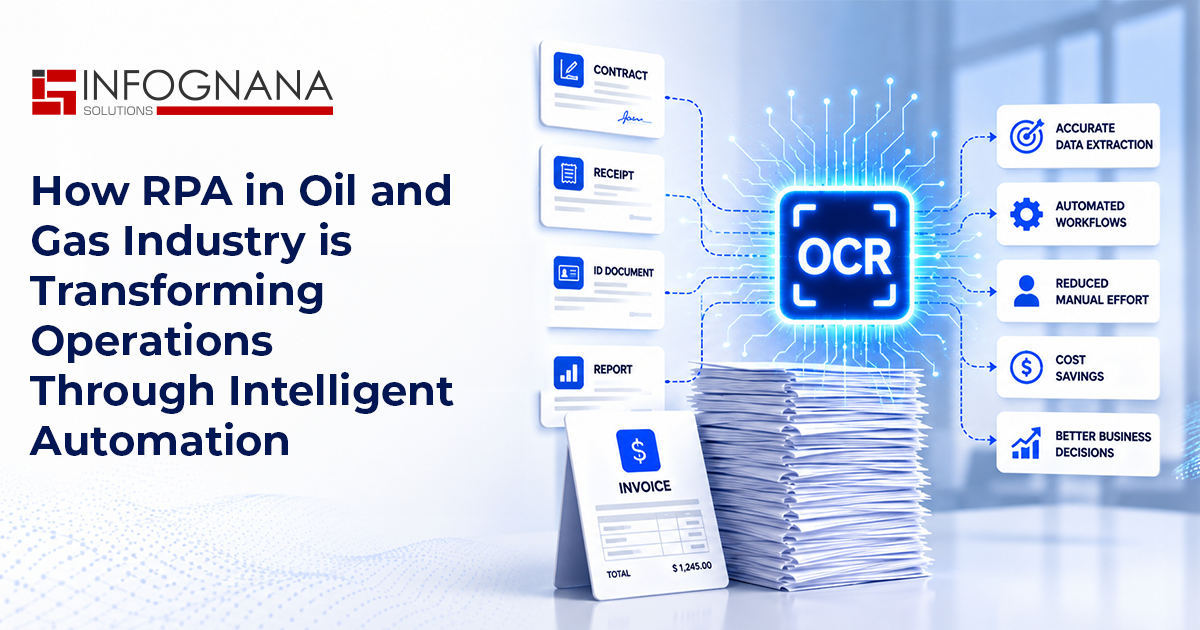
The Oil and Gas industry serves as the backbone of global economies, supporting energy production, transportation, manufacturing, and modern infrastructure. However, organizations operating across upstream, midstream, and downstream sectors face increasing challenges in managing large-scale operations, regulatory requirements, and data-intensive workflows.
To stay competitive in an evolving market, companies are increasingly implementing RPA in Oil and Gas industry processes and investing in advanced Oil and Gas automation solutions. By combining Robotic Process Automation (RPA), Artificial Intelligence (AI), and intelligent workflow technologies, organizations can improve efficiency, reduce costs, and optimize operational performance without replacing existing systems.
Why Automation Matters in the Oil and Gas Industry
Oil and Gas organizations process massive volumes of operational data every day. Activities such as exploration analysis, drilling reports, equipment monitoring, maintenance scheduling, supply chain management, and financial documentation require speed and accuracy.
Manual processing often creates challenges including:
- Delays in operational workflows
- Human errors in data handling
- Increased operational expenses
- Regulatory compliance risks
- Lower productivity levels
- Limited visibility across operations
This is where RPA in Oil and Gas industry operations delivers significant value. Software bots automate repetitive and rule-based processes, allowing employees to focus on strategic activities and higher-value business functions.
Addressing Common Automation Challenges in Oil and Gas
Integration with Legacy Systems
Many organizations assume digital transformation requires replacing existing infrastructure and enterprise systems. Since large Oil and Gas companies often operate on legacy software platforms, modernization can appear expensive and disruptive.
Modern Oil and Gas automation solutions eliminate these concerns. RPA bots interact with applications the same way employees do, enabling businesses to automate workflows without extensive system redevelopment or costly integrations.
Benefits include:
- Minimal infrastructure disruption
- Faster implementation
- Lower technology investment costs
- Improved operational continuity
- Seamless workflow automation
Strengthening Data Security and Compliance
Data security remains critical for Oil and Gas companies managing sensitive engineering, operational, and financial information.
Advanced automation platforms include enterprise-grade security capabilities such as:
- Role-based access controls
- Encrypted data processing
- Audit trails and activity monitoring
- Credential management systems
- Secure cloud deployment environments
With a structured automation strategy, organizations can strengthen governance while maintaining operational efficiency.
Addressing Common Automation Challenges in Oil and Gas
Smarter Data Management
Data drives every operational decision in Oil and Gas environments. Engineering diagrams, production records, inspection reports, maintenance documentation, and compliance files require accurate management.
AI-powered Oil and Gas automation solutions help organizations:
- Extract information from engineering documents
- Convert unstructured data into organized formats
- Classify operational records automatically
- Improve information retrieval speed
- Enable real-time operational visibility
Converting large volumes of raw data into actionable insights enables faster and more informed decision-making.
Improved Regulatory Compliance
The Oil and Gas sector operates under strict environmental, operational, and financial regulations. Manual reporting processes often increase the risk of missed deadlines and reporting inaccuracies.
RPA in Oil and Gas industry operations helps automate:
- Regulatory reporting
- Audit documentation
- Data validation
- Compliance monitoring
- Workflow verification
Automation improves consistency while reducing administrative effort and compliance risks.
Increased Workforce Productivity
Automation is not only about reducing costs—it also improves workforce performance.
When repetitive tasks are automated, employees can focus on:
- Strategic planning
- Operational analysis
- Innovation initiatives
- Problem-solving activities
- Process optimization
This improves employee efficiency while creating opportunities for higher-value work.
Reduced Operational Costs
One of the most significant advantages of implementing Oil and Gas automation solutions is operational cost reduction.
RPA improves efficiency through:
- Faster workflow execution
- Reduced administrative workloads
- Lower processing errors
- Minimized downtime
- Better resource utilization
Organizations can scale operations more effectively while maintaining cost efficiency.
How Infognana Supports Oil and Gas Automation
Infognana helps organizations modernize complex energy operations through AI-powered automation and intelligent workflow solutions. By combining advanced technologies with industry expertise, businesses can simplify processes and improve operational outcomes.
Infognana solutions help companies:
- Convert unstructured data into actionable intelligence
- Automate repetitive operational processes
- Improve reporting accuracy
- Strengthen compliance management
- Increase efficiency across departments
By leveraging AI and RPA in Oil and Gas industry operations, businesses can accelerate digital transformation and create long-term operational value.
Transform Your Oil and Gas Operations with Intelligent Automation
As the energy landscape continues evolving, automation is becoming a strategic requirement rather than a competitive advantage.
Organizations implementing advanced Oil and Gas automation solutions can improve efficiency, reduce costs, strengthen compliance, and create sustainable operational growth.
Partner with Infognana to streamline workflows, optimize data management, and transform Oil and Gas operations with intelligent automation.