Businesses today handle an enormous amount of information every day — invoices, receipts, contracts, customer records, forms, medical files, and many other document types. While organizations are becoming more digital, many teams still spend valuable time manually entering data, organizing files, and processing paperwork.
Manual document handling often creates challenges. It slows operations, increases administrative effort, and can lead to errors that affect productivity and decision-making. This is where Optical Character Recognition (OCR) is creating a significant impact.
Modern OCR technology has evolved far beyond simple text scanning. In 2026, businesses are using OCR document processing and AI document extraction technologies to automate workflows, improve accuracy, and transform how information is managed across departments.
Whether an organization operates in healthcare, finance, retail, legal services, or logistics, OCR technology has become an important part of digital transformation strategies.
What is Optical Character Recognition (OCR)?
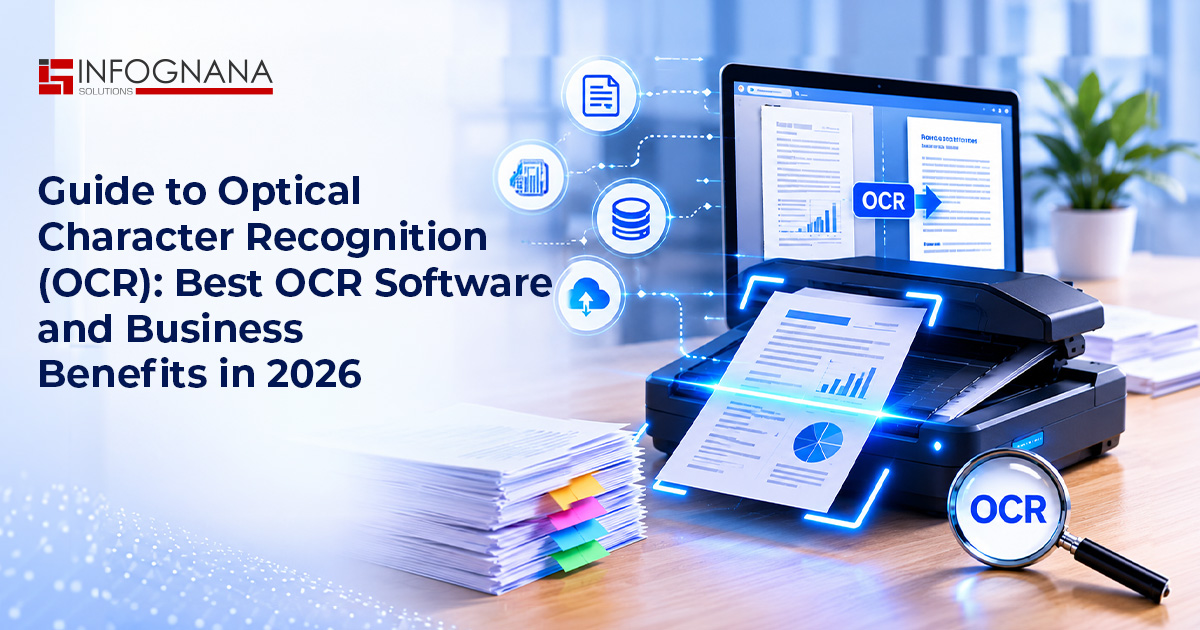
Optical Character Recognition (OCR) is a technology that converts text from images, scanned documents, PDFs, and handwritten content into machine-readable digital information.
Instead of manually typing information from paper documents into systems, OCR software automatically identifies and extracts text for processing and storage.
Modern OCR platforms now combine multiple technologies such as:
- Artificial Intelligence (AI)
- Machine Learning (ML)
- Natural Language Processing (NLP)
- Intelligent Document Processing (IDP)
These technologies help software understand document structures and improve recognition accuracy even when processing complex layouts.
Businesses commonly use OCR for:
- Invoice processing
- Receipt data extraction
- Contract digitization
- Identity verification
- Medical records
- Financial document automation
- Customer onboarding processes
How OCR Document Processing Works
OCR systems follow a series of steps to convert physical documents into usable digital information.
Document Capture
Documents enter the system through various channels including:
- Scanners
- Mobile devices
- Email attachments
- Cloud storage
- Enterprise applications
Image Optimization
Before text extraction begins, the system enhances image quality by:
- Removing noise
- Correcting image skew
- Adjusting brightness
- Improving contrast
This improves recognition performance.
Text Recognition
AI-powered OCR engines then analyze:
- Printed text
- Numbers
- Tables
- Handwritten information
- Forms
- Document layouts
Machine learning models continue improving recognition accuracy over time.
AI Document Extraction
After recognizing text, the system extracts key information and organizes it into structured formats that can be sent directly into:
- ERP systems
- CRM platforms
- Databases
- Accounting software
- Business applications
Why Businesses Are Investing in OCR Technology
Organizations are increasingly adopting OCR because manual document processes consume time and resources.
Faster Processing Speed
Tasks that once required hours can often be completed within seconds using OCR automation.
Improved Data Accuracy
Manual data entry can introduce mistakes. OCR systems reduce errors and improve consistency across processes.
Lower Operational Costs
Reducing repetitive manual work helps businesses optimize resource allocation and minimize processing costs.
Better Compliance
Digital document records make audits and regulatory reporting easier to manage.
Improved Access to Information
Digitized information becomes searchable, allowing employees to retrieve important documents quickly.
Essential Features to Look for in OCR Software
Choosing OCR software involves more than basic text extraction. Businesses should evaluate solutions that support long-term scalability and automation.
AI-Powered Recognition
Modern OCR platforms use artificial intelligence to improve recognition quality and understand document context.
Multi-Language Capabilities
Global organizations benefit from platforms that support multiple languages.
Batch Processing
High-volume processing allows businesses to manage thousands of documents simultaneously.
Cloud and ERP Integration
Seamless integration with existing systems improves workflow efficiency.
Security Features
Enterprise OCR solutions should provide:
- Data encryption
- Access control
- Audit logs
- Compliance management
Best OCR Software in 2026
ABBYY FineReader
ABBYY FineReader is recognized for strong text recognition accuracy and advanced PDF management capabilities.
Adobe Acrobat Pro
Adobe Acrobat Pro combines OCR with powerful document editing functionality.
Tesseract OCR
Tesseract remains one of the most widely used open-source OCR engines for developers and automation projects.
Infognana Intelligent OCR Solutions
Infognana provides AI document extraction and intelligent automation capabilities designed for enterprise document processing.
Features include:
- Automated document classification
- Structured and unstructured data extraction
- Workflow automation
- ERP integration
- Secure cloud deployment
Google Drive OCR
Google Drive offers built-in OCR functionality for extracting text from images and PDF files.
Microsoft OneNote OCR
Microsoft OneNote includes image-to-text capabilities for quick information extraction.
Readiris
Readiris combines OCR functionality with document management tools.
OCR Applications Across Industries
Healthcare
Healthcare providers use OCR to digitize patient information and streamline administrative workflows.
Finance
Financial institutions automate invoices, receipts, and document verification processes.
Legal Services
Law firms use OCR technology to organize contracts and improve document retrieval.
Logistics
Shipping labels, customs forms, and inventory documents can be processed automatically.
Retail and E-commerce
Retail businesses use OCR to improve supplier management and automate receipt processing.
The Future of AI Document Extraction
OCR technology continues advancing with AI and machine learning innovations.
Future developments may include:
- Real-time document processing
- Enhanced handwriting recognition
- Intelligent fraud detection
- Predictive analytics
- Voice-assisted data capture
As organizations continue creating and managing large volumes of information, OCR technology will continue playing a major role in business automation.
Improve Business Efficiency with Intelligent OCR Solutions
Organizations looking to improve document workflows are increasingly adopting OCR document processing and AI document extraction solutions to reduce manual effort and improve operational efficiency.
With intelligent automation technologies becoming more advanced, businesses can transform traditional document management into faster, smarter, and more scalable digital processes.