In today’s data-driven business environment, organizations generate massive volumes of information every day. From customer records and invoices to operational reports and digital forms, businesses rely on accurate data to improve efficiency and make informed decisions. However, collecting information alone is not enough. Raw data must be captured, organized, and transformed into meaningful insights that support business growth.
This is where data entry services, data processing services, and data digitization services play a critical role. While these terms are often used interchangeably, they serve different purposes within the data lifecycle. Understanding the differences can help businesses improve operational efficiency, enhance decision-making, and leverage automated data processing technologies effectively.
What is Data Entry?
Data entry is the process of collecting and entering raw information into digital systems from multiple sources such as physical documents, scanned files, handwritten forms, spreadsheets, and databases.
The primary purpose of data entry services is to ensure that information is accurately recorded, stored, and made accessible for future use.
Common Uses of Data Entry Services
Customer Information Management
Businesses enter customer details into CRM platforms for better relationship management and communication.
Form and Document Digitization
Paper documents, handwritten notes, and forms are converted into digital records using data digitization services.
Product Database Updates
E-commerce companies continuously update product information and inventory records.
Survey and Research Data Collection
Organizations compile and organize survey responses for future analysis.
Financial Data Recording
Invoices, payment information, and operational records are entered into secure systems.
Accurate data entry services create a strong foundation for successful data analysis and business intelligence.
What is Data Processing?
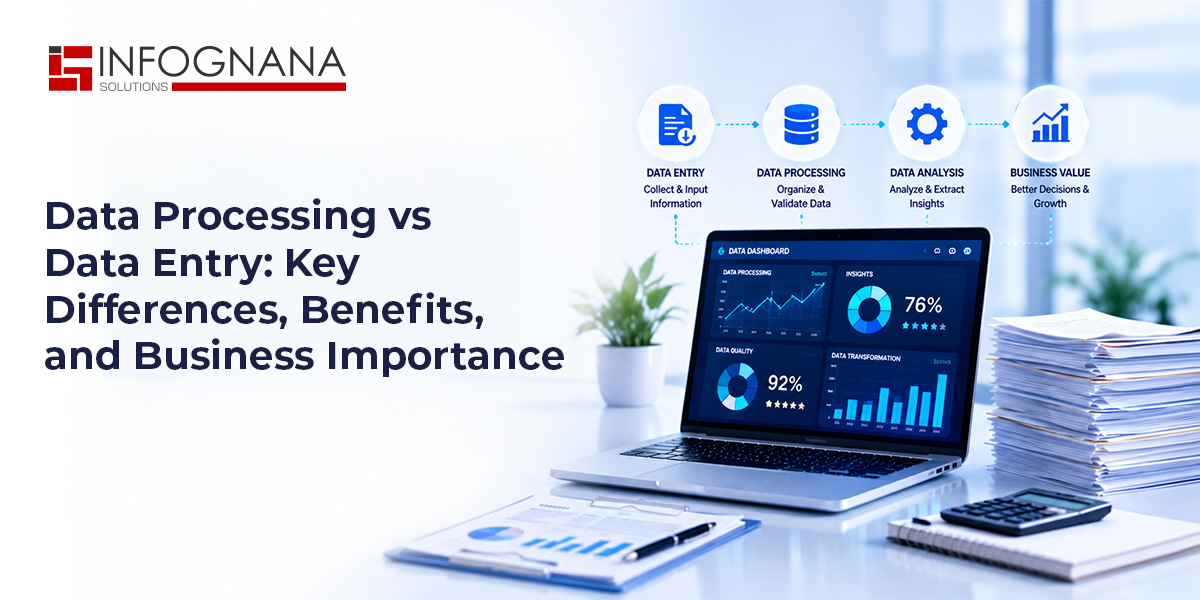
Data processing refers to converting raw information into meaningful and usable insights through various stages such as collection, validation, organization, analysis, and reporting.
Modern data processing services enable organizations to extract value from large datasets efficiently.
Businesses use automated data processing to:
- Identify patterns and trends
- Correct inaccurate information
- Organize large datasets
- Generate reports and dashboards
- Improve business decisions
- Reduce manual workload
Through intelligent automation and AI technologies, automated data processing significantly improves speed and accuracy.
Data Processing vs Data Entry: Understanding the Key Difference
The major difference between the two lies in their objectives.
Data Entry Services
- Focus on capturing and storing information
- Convert raw information into digital format
- Prioritize accuracy and organization
Data Processing Services
- Focus on transforming data into meaningful insights
- Analyze and interpret information
- Support decision-making processes
Simply put, data entry services collect data, while data processing services transform data into valuable business intelligence.
Types of Data Entry Services
Different industries require various forms of data entry services depending on their operational needs.
Automated Data Entry
Uses AI, OCR, and intelligent systems to automatically capture information from documents and images while reducing manual work.
Online Data Entry
Cloud-based platforms enable real-time access and collaboration across teams.
Offline Data Entry
Converts physical documents into digital files for later use.
Manual Data Entry
Human operators manually enter information when complex or unstructured data requires review.
Image-Based Data Entry
Extracts text and information from scanned documents using OCR technology and data digitization services.
Types of Data Processing Services
Batch Data Processing
Large amounts of information are processed at scheduled intervals. This method is commonly used for payroll and financial reporting.
Real-Time Processing
Data is analyzed immediately after generation, supporting applications like fraud detection and transaction monitoring.
Distributed Processing
Tasks are divided across multiple systems to improve scalability and performance.
Manual Processing
Human-driven processing methods are used in low-volume environments.
Cloud-Based Processing
Cloud infrastructure allows businesses to scale operations while reducing costs and improving accessibility.
Many organizations now adopt automated data processing for faster and more accurate outcomes.
Benefits of Data Entry Services
Actionable Business Insights
Raw information is transformed into meaningful intelligence.
Faster Decision-Making
Organizations can respond quickly using real-time data.
Better Business Intelligence
Businesses gain a clearer understanding of trends, risks, and opportunities.
Increased Operational Efficiency
Automated data processing reduces manual effort and improves productivity.
Why Businesses Need Both Data Entry and Data Processing
Data management becomes effective only when data collection and analysis work together.
Without accurate data entry services, businesses may struggle with poor data quality. Without proper processing, data remains unused and provides limited value.
Combining both services supports:
- Predictive analytics
- Customer behavior analysis
- Business intelligence systems
- Operational optimization
- Strategic planning
Industry Applications
Healthcare
Managing patient records, claims processing, and medical documentation.
Banking and Finance
Transaction processing, fraud monitoring, and risk management.
Retail and E-commerce
Customer analytics, inventory tracking, and sales reporting.
Logistics
Shipment monitoring and supply chain management.
Education
Managing student records and academic data.
Insurance
Claims processing and policy validation.
Why Outsource Data Entry and Data Processing Services?
Managing large volumes of information internally often increases operational costs and workload. Outsourcing data entry services, data processing services, and data digitization services allows businesses to access specialized expertise and advanced technology.
Key Benefits of Outsourcing
- Reduced operational expenses
- Faster project turnaround times
- Access to skilled professionals
- Improved quality control
- Scalability and flexibility
- Advanced automated data processing capabilities
Outsourcing helps organizations focus on core business operations while ensuring efficient data management.
The Future of Data Management
As businesses continue generating larger amounts of information, the demand for AI-driven solutions and automated data processing will continue to grow. Organizations are increasingly adopting data digitization services and intelligent technologies to improve speed, accuracy, and operational agility.
Businesses investing in modern data processing services today will be better positioned to gain competitive advantages, improve decision-making, and drive long-term growth.