In today’s data-driven business environment, organizations generate enormous volumes of information from websites, customer interactions, applications, sales systems, and operational platforms. However, collecting data alone is not enough. Businesses need effective methods to store, organize, and extract valuable insights from that information to make informed decisions.
Two technologies that play a major role in modern data management are Data Mining and Data Warehousing. While many businesses use these terms together, they perform different functions within a data ecosystem. Understanding Data Mining vs Data Warehousing helps organizations build stronger data strategies and unlock greater business value.
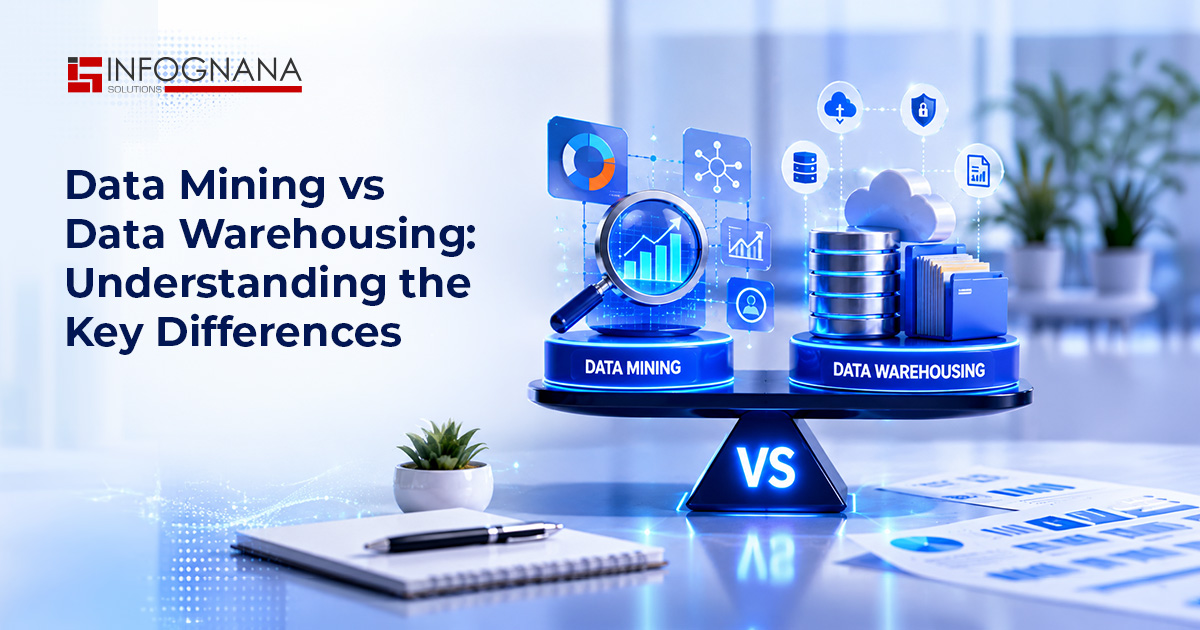
Data Warehousing focuses on organizing and storing data, while Data Mining focuses on analyzing that data to uncover patterns, trends, and actionable insights.
What is Data Mining?
Data Mining is the process of analyzing large datasets to discover hidden patterns, relationships, and meaningful insights. It uses technologies such as Artificial Intelligence (AI), Machine Learning (ML), predictive analytics, and statistical algorithms to convert raw information into useful business intelligence.
The main objective of data mining is to identify valuable information that supports smarter business decisions and operational improvements.
Businesses commonly use Data Mining for:
- Customer behavior analysis
- Fraud detection
- Sales forecasting
- Market trend analysis
- Risk management
- Product recommendations
- Customer segmentation
For example, e-commerce companies use data mining techniques to analyze customer buying behavior and recommend products based on previous purchases and browsing history.
Key Techniques Used in Data Mining
Pattern Recognition
Pattern recognition identifies recurring trends and behaviors within large datasets. Businesses use this technique to understand purchasing habits and customer activities.
Predictive Analytics
Predictive analytics uses historical data to forecast future outcomes such as customer churn, demand forecasting, or revenue growth.
Classification
Classification categorizes information into predefined groups. A common example includes filtering spam emails from legitimate communications.
Clustering
Clustering groups similar data points together based on shared characteristics. Businesses frequently use clustering for audience segmentation and personalized marketing campaigns.
Association Analysis
Association analysis identifies relationships between variables and behaviors. Retail businesses often use this technique to understand products frequently purchased together.
What is Data Warehousing?
Data Warehousing refers to the process of collecting, organizing, and storing information from multiple systems into a centralized repository. A Data Warehousing solution acts as a single source of truth that enables organizations to access both historical and current business data efficiently.
Rather than analyzing raw operational data directly, businesses use data warehouses to create optimized environments for reporting, analytics, and business intelligence.
A modern Data Warehousing environment may collect information from:
- ERP systems
- CRM platforms
- Financial software
- Marketing tools
- Operational databases
- External data sources
Centralized storage improves data consistency, accessibility, and overall reporting efficiency.
How Data Warehousing Works
Data warehouses typically use an ETL process:
Extract
Data is gathered from multiple internal and external systems.
Transform
The collected data is cleaned, standardized, and organized into a usable format.
Load
Processed data is stored within the data warehouse for reporting and analysis purposes.
Modern cloud-based data warehousing platforms also provide scalability, flexibility, and faster data processing capabilities.
Key Features of Data Warehousing
Centralized Data Storage
Data warehouses combine information from multiple systems into one secure and organized repository.
Historical Data Management
Organizations can store years of historical data for trend analysis and long-term business planning.
Faster Reporting
Optimized database structures enable faster queries, reporting, and dashboard generation.
Scalability
Cloud-based data warehousing solutions support growing volumes of structured and semi-structured data.
Business Intelligence Integration
Data warehouses integrate with analytics platforms and BI tools for advanced reporting and visualization.
Data Mining vs Data Warehousing: Key Differences
Although both technologies support business intelligence and decision-making, their functions differ significantly.
Purpose
Data Mining: Focuses on analyzing information and discovering patterns.
Data Warehousing: Focuses on storing and organizing information.
Functionality
Data Mining: Interprets and analyzes datasets.
Data Warehousing: Manages and maintains structured repositories.
Data Sources
Data Mining: Uses existing datasets for analysis.
Data Warehousing: Collects and consolidates data from multiple systems.
Technologies Used
Data Mining: Uses AI, Machine Learning, statistical models, and predictive analytics.
Data Warehousing: Uses ETL tools, database systems, and cloud infrastructure.
Business Applications
Data Mining: Fraud detection, customer analysis, forecasting, and trend identification.
Data Warehousing: Reporting, KPI monitoring, dashboard creation, and business intelligence.
Focus Area
Data Mining: Extracting insights from data.
Data Warehousing: Structuring and storing data efficiently.
How Data Mining and Data Warehousing Work Together
Data Mining vs Data Warehousing should not be viewed as competing technologies because they work together to create intelligent business ecosystems.
A Data Warehousing platform stores and organizes information in a structured environment, while Data Mining extracts valuable insights from that data.
When combined, they help businesses:
- Improve decision-making
- Increase operational efficiency
- Predict customer behavior
- Reduce business risks
- Enhance business performance
- Support digital transformation
Organizations using both technologies gain a stronger foundation for data-driven growth.
Business Benefits of Data Mining and Data Warehousing
Better Decision-Making
Businesses gain real-time visibility into customer behavior, operations, and performance metrics.
Improved Operational Efficiency
Centralized systems and automation reduce manual processes and improve productivity.
Enhanced Customer Experience
Data insights help businesses deliver personalized experiences and targeted marketing strategies.
Stronger Risk Management
Predictive analytics enables early identification of risks, fraud, and compliance concerns.
Scalability for Future Growth
Modern data platforms can handle increasing business demands and growing datasets.
Industries Using Data Mining and Data Warehousing
Many industries rely on Data Mining and Data Warehousing technologies, including:
- Healthcare
- Banking and Finance
- Retail and E-commerce
- Manufacturing
- Insurance
- Telecommunications
- Logistics
- Education
These industries use data intelligence to improve efficiency, reduce costs, and maintain competitive advantages.
Transform Data into Business Intelligence with Infognana
Infognana helps organizations modernize data management through advanced Data Warehousing, AI-powered analytics, and intelligent Data Mining solutions.
Our solutions help businesses:
- Centralize enterprise data
- Extract insights from structured and unstructured information
- Improve reporting and analytics
- Automate data workflows
- Increase operational efficiency
- Support smarter business decisions
By combining scalable technology with intelligent automation, Infognana empowers organizations to transform raw data into actionable business intelligence.
The Future of Data Mining and Data Warehousing
As businesses continue generating large amounts of information, the demand for smarter data management solutions will continue growing. Organizations investing in modern Data Mining and Data Warehousing technologies will be better equipped to make faster decisions, improve customer experiences, and maintain a competitive edge in the digital economy.
Infognana delivers intelligent data solutions designed to turn complex information into meaningful business outcomes.