Healthcare organizations today focus not only on delivering quality care but also on maintaining financial stability and operational efficiency. As healthcare costs continue to shift toward patients, transparent billing communication has become increasingly important.
One critical yet often underestimated component of Revenue Cycle Management (RCM) is Patient statements in healthcare RCM. Effective patient statements help healthcare providers improve payment collections, enhance transparency, and create a better patient experience.
Well-designed statements simplify financial communication and reduce confusion, helping organizations strengthen patient trust while improving cash flow.
What Are Patient Statements in Healthcare?
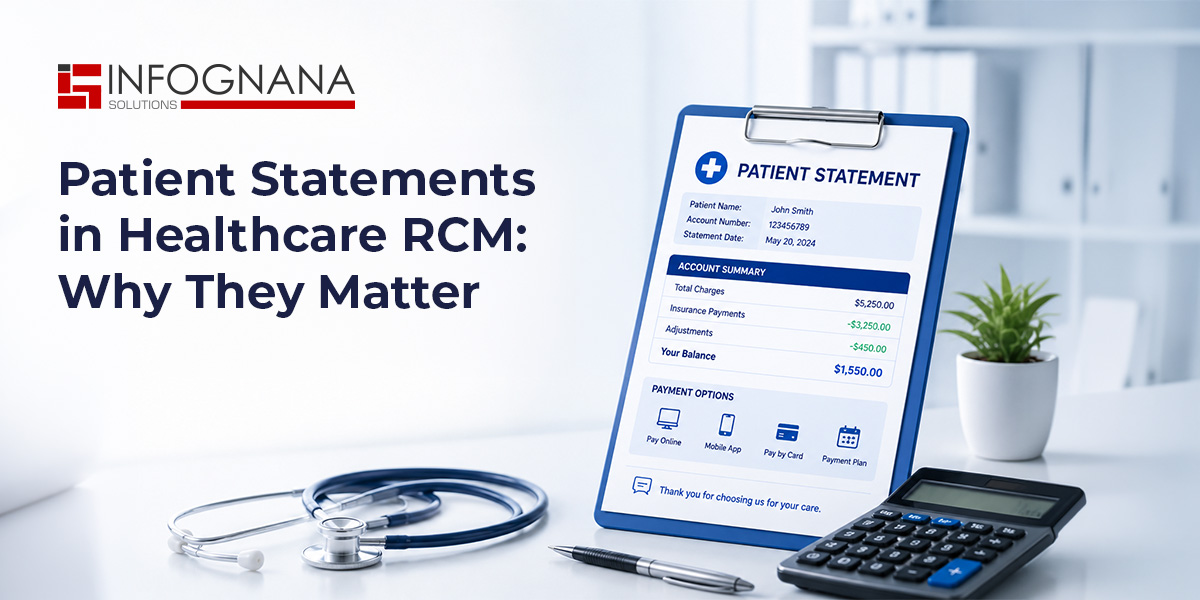
Patient statements are billing documents provided to patients after insurance claims have been processed. These statements explain healthcare charges, insurance payments, adjustments, and the remaining amount owed by the patient.
Within Revenue Cycle Management, patient statements act as a communication bridge between providers and patients, ensuring that financial responsibilities are clearly understood.
Key Components of Patient Statements
A well-structured patient statement typically includes:
- Patient identification and account information
- Date of medical services provided
- Itemized procedures and treatments
- Total healthcare charges
- Insurance coverage and payment details
- Remaining patient balance
- Payment due dates
- Available payment methods
- Contact information for billing support
Modern healthcare organizations deliver statements through multiple channels including:
- Patient portals
- Mobile applications
- Traditional mail
Multiple communication options improve accessibility and increase patient engagement
The Role of Patient Statements in Revenue Cycle Management
Patient statements have a direct impact on financial performance and operational efficiency within Revenue Cycle Management.
1. Improving Financial Transparency
Patients frequently struggle to understand medical bills because of complex terminology and insurance adjustments. Clear patient statements reduce confusion and help establish trust.
2. Accelerating Payment Collection
Easy-to-read statements encourage patients to make payments faster. Faster payments improve revenue flow and reduce outstanding balances.
3. Reducing Revenue Leakage
Accurate billing minimizes unpaid balances, billing disputes, and missed collections that can negatively affect financial performance.
4. Enhancing Operational Efficiency
Automated patient statement processes reduce administrative workload and support more effective billing operations.
Why Patient Statements Matter Beyond Billing
Patient statements are more than payment documents. They contribute significantly to the overall patient experience.
Better Patient Engagement
Clear communication creates stronger relationships between patients and healthcare providers.
Improved Patient Satisfaction
Patients appreciate transparency and detailed explanations of healthcare costs.
Support for Financial Planning
Flexible payment arrangements and detailed cost breakdowns help patients better manage medical expenses.
Compliance and Documentation
Accurate patient statements support healthcare documentation requirements and regulatory compliance.
Common Challenges in Managing Patient Statements
Many healthcare organizations still face obstacles when managing patient statement processes.
Complex Billing Language
Medical terminology and insurance coding frequently create confusion among patients.
Billing Errors
Data inaccuracies and coding mistakes can delay reimbursements and trigger disputes.
Delayed Statement Delivery
Late communication often leads to slower collections.
Administrative Burden
Manual statement creation consumes staff time and resources.
Patient Billing Disputes
Unclear financial information often increases patient inquiries and payment delays.
Best Practices for Effective Patient Statement Management
Healthcare organizations can improve Patient statements in healthcare RCM by adopting the following strategies:
- Use clear, patient-friendly language
- Provide detailed billing summaries
- Offer digital and mobile-friendly statements
- Enable SMS, email, and portal communication
- Integrate secure online payment systems
- Offer flexible payment plans
- Automate statement generation
- Implement data validation for improved accuracy
How Medical Billing Services Improve Patient Statement Processes
Professional Medical billing services help healthcare providers streamline patient communication and optimize billing workflows.
Benefits include:
- Increased billing accuracy
- Reduced claim errors
- Faster reimbursement cycles
- Improved patient communication
- Reduced administrative workload
- Better payment collection rates
By integrating advanced billing technology and automation, healthcare organizations can improve both patient satisfaction and financial outcomes.
Secure and Compliant Patient Communication
Protecting patient billing information remains a priority within Revenue Cycle Management.
Important Considerations
Data Security
- Secure transmission of billing data
- Encryption of sensitive information
- Role-based access controls
Patient Support Services
- Dedicated billing assistance teams
- Secure communication channels
- Faster dispute resolution processes
Flexible Payment Options
- Online payment portals
- Installment payment plans
- Multiple digital payment methods
Secure and seamless communication improves both patient trust and payment performance.
Transforming Revenue Cycle Operations with Infognana
At Infognana, we help healthcare organizations optimize Revenue Cycle Management using intelligent automation, healthcare expertise, and technology-driven solutions.
Our healthcare-focused solutions improve:
- Billing accuracy
- Patient communication
- Payment collections
- Administrative efficiency
- Revenue cycle performance
From patient statement management to end-to-end Medical billing services, our solutions help healthcare providers focus more on delivering exceptional patient care.
Conclusion
Patient statements in healthcare RCM play an essential role in improving financial transparency and strengthening patient relationships. Clear, accurate, and automated statements help healthcare organizations accelerate collections, reduce billing disputes, and improve operational efficiency.
Healthcare providers that invest in effective patient statement strategies are better positioned to achieve sustainable financial growth while delivering a better patient experience.